The Moon is home to many humanoid and non-humanoid intelligent species. However, three humanoids stand out as particularly noteworthy, as their civilisations have dominated the silver globe for millennia: the elfin lunarians, the winged batkin, and the insectoid selenites.
LUNARIANS
Lunarians are the Moon equivalent of humans. They are short and have black almond-shaped eyes and large pointed ears. Those who hail from Zarthoris Plenia in the north usually have ghostly white complexions, while ash-grey predominates among the folk of Issum and Irdonozur in the east. The inhabitants of the western cities, Orob and Dervat, tend toward jet-black skin. Their hair and beards come in the same monochromatic range, but it is quite common for lunarians to lack hair growth.
Lunarians are oviparous, and the eggs are incubated in special hatching chambers for five years. They have developed several methods to prolong life and may generally look forward to a life expectancy of well beyond 300 years. The rich and mighty often live more than twice as long. Despite this, they are a dying people, as they are infertile, and lunarian children are rare.
The Lunarians live in competing city-states, each with its own unique character and ancient traditions. Their culture is more varied than that of the batkin or selenites. What they have in common, however, is that they are all strict caste societies with an aristocracy that rules over a motley crowd of commoners and an oppressed slave caste. The castes are signified by the color of their clothes. Only members of the nobility may wear the lustrous silver cloth, while the priestly caste robe themselves in pure white. The color of the warrior’s cloak is somber black, and the commoners may dress only in tunics of a drab grey hue.
Lunarian culture is characterized by the realization that their world is doomed, and the dominant view is that sensual pleasure is the only thing that has any real value. To tease their jaded senses, they engage in bloody gladiatorial games, hallucinogenic drugs, debauched festivities, and ecstatic religiosity.
BATKIN
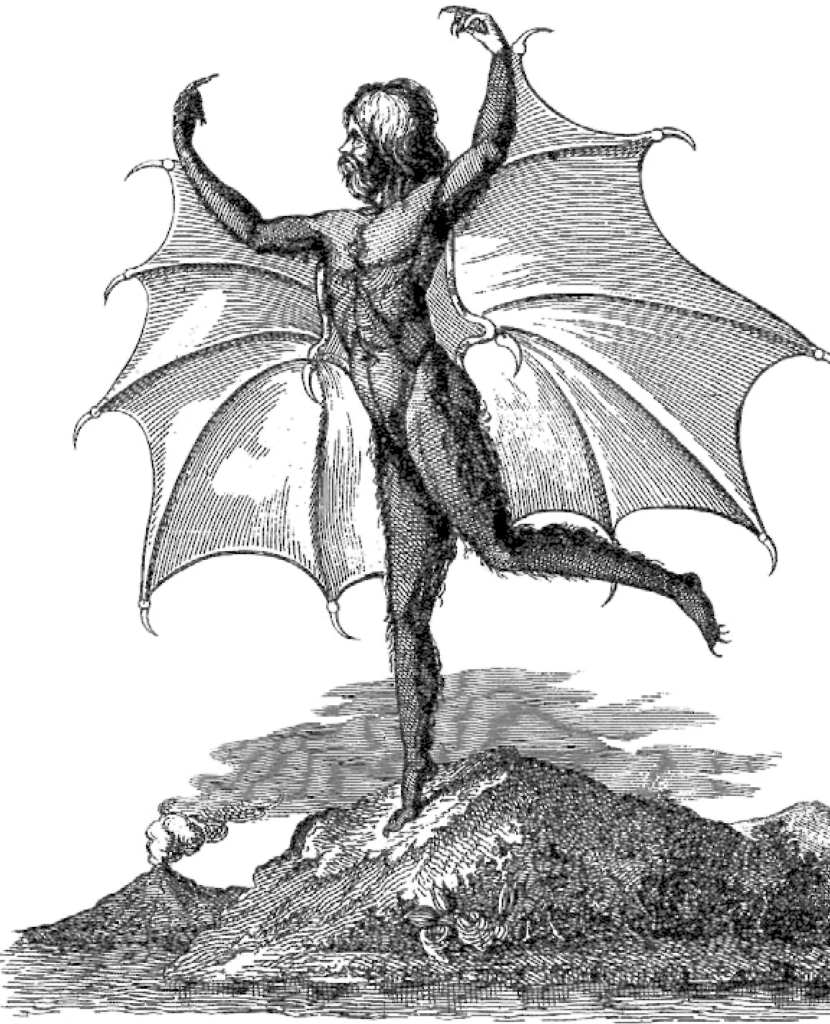
The Batkin, a nocturnal race of winged humanoids, are cloaked in short, dark fur. They stand between 4½ and 5 feet in height, weigh a mere 50 pounds, and possess an impressive wingspan of 15 feet, giving them a distinct resemblance to bats.
Their domain, the Pale Highlands, is a desolate expanse of isolated, lofty caves, difficult to access and thus ideally suited to their needs. The Batkin’s society is tribal and semi-nomadic, characterized by a predatory nature and a fierce emphasis on group loyalty and warfare. Subsistence is achieved through a mix of hunting, gathering, plunder, and the occasional foray into horticulture and barter. The five largest tribes, each of which dominates a horde of several lesser tribes, are the Bazgoors, the Gargurs, the Nazdraks, the Ukbars, and the Zuzurgs.
Batkin tribes are ruled by a tribal council presided over by a chieftain. In the elections for the council, male batkin who have participated in a raiding party and earned the title of warrior are eligible as candidates, while female batkin who have become mothers have suffrage. Those batkin who do not fit either of those categories have no say in the council, but may be recruited to the tribe’s circle of witches who preside over the reading of augurs and communing with the spirits of the ancestors.
Perpetually at odds with the Lunarians, who are both more organized and technologically advanced, the Batkin employ their superior mobility and guerrilla tactics to considerable effect. Yet, their potential for dominance is undermined by incessant internal rivalries, preventing the tribes from uniting against their common foe.
SELENITES
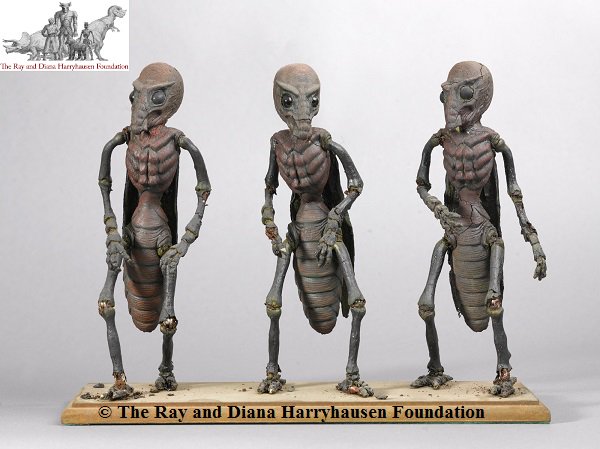
Selenites are a species of underground insectoids. Their societies are strongly collectivist and hierarchical, and they have at best a dim sense of individuality. Selenites instinctively prioritize the needs of the group over personal desires and are uncomfortable in situations where their roles are not clearly defined.
They live in large cities beneath the lunar surface, where they grow mushrooms and raise giant larvae. All Selenite colonies obey the Grand Selenite, the immortal super-intellect that coordinates all activity of their species.
The Selenites are the only one of the three main lunar civilisations that has preserved much of the highly developed technology mastered by their ancestors. At the rare occasions when Selenites venture out of their underground lairs, they astonish the surface dwellers with such marvels as hovercraft, remote communication devices, and lightning guns.