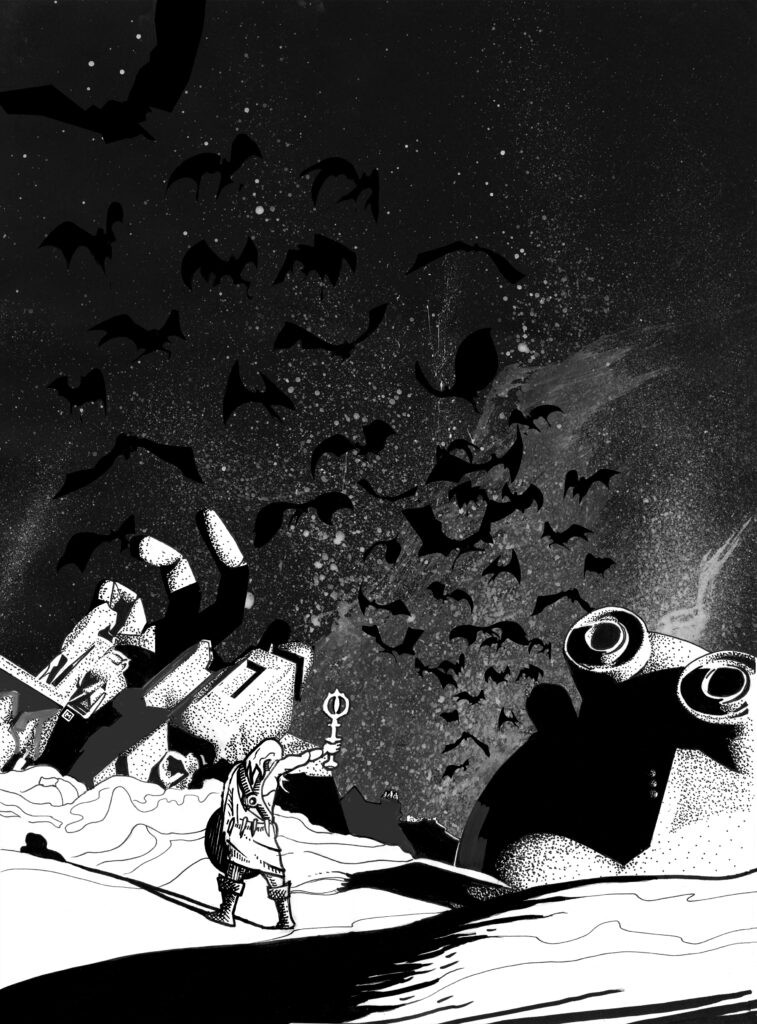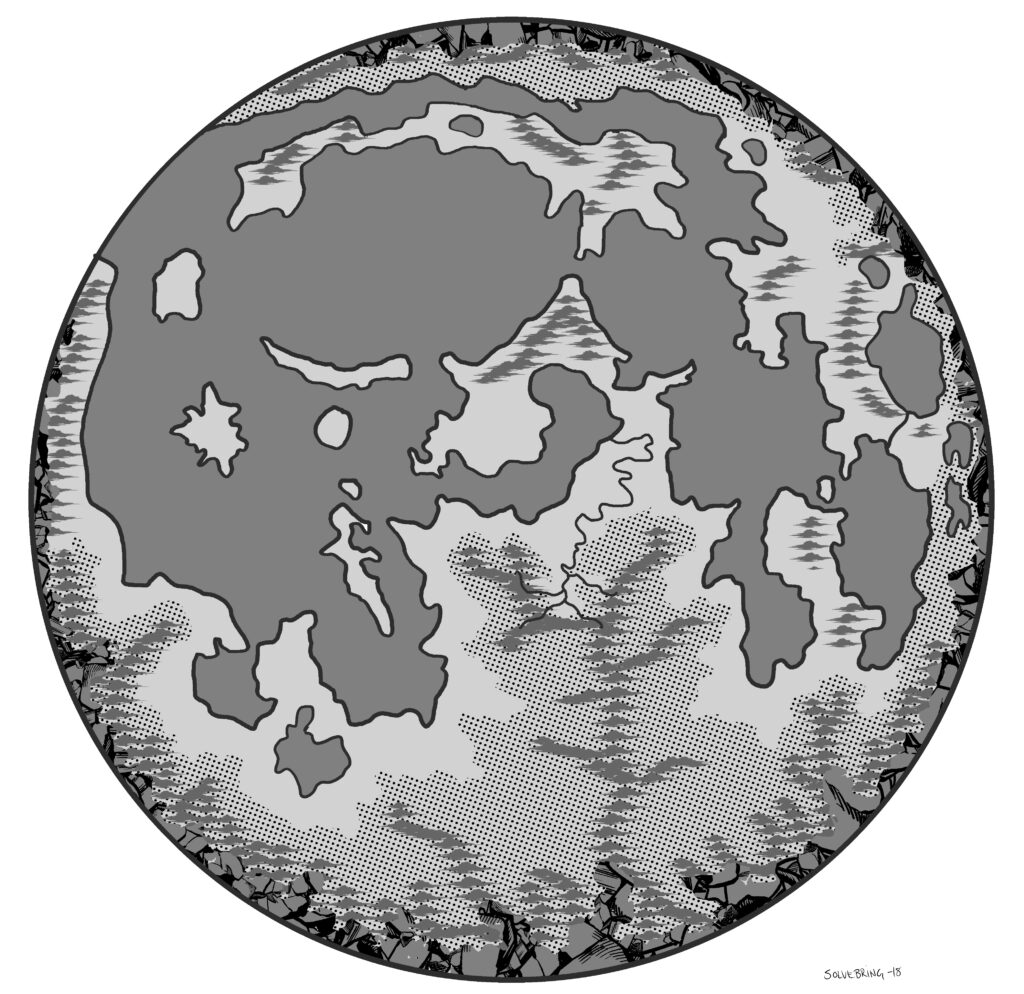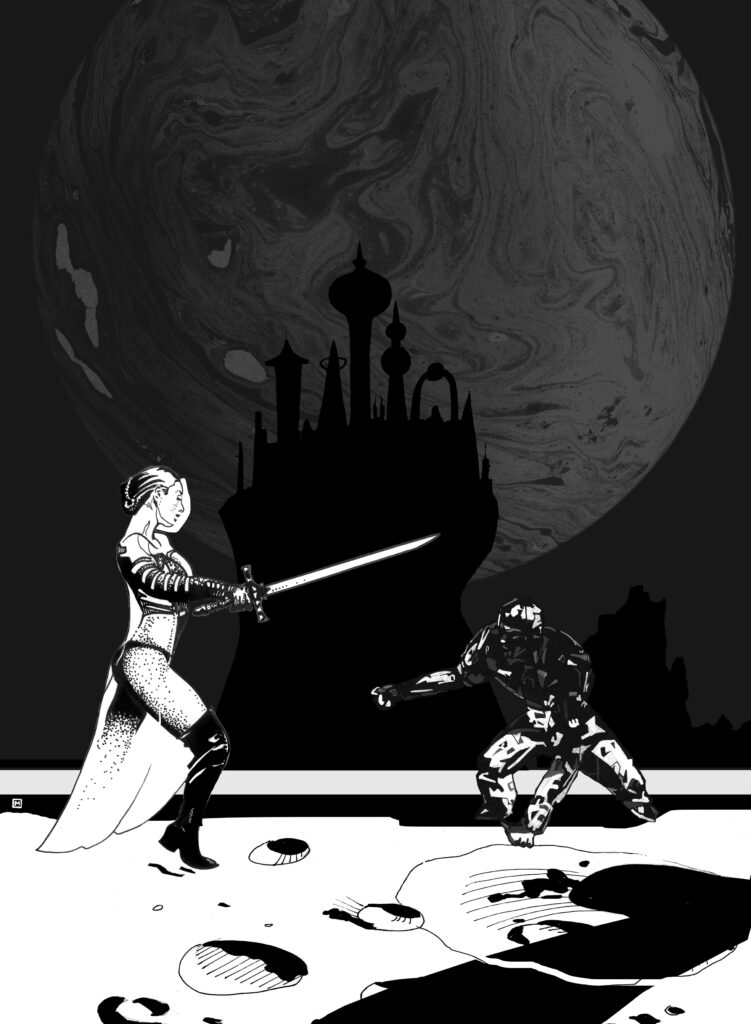
The Moon is home to a great variety of creatures, most of which are indigenous to its eldritch orb, but some stem from Earth or other nearby planets, and others originate on strange worlds never touched by the light of the sun.
Common plants of the moon
Many of the lunar plants release swarms of pollen or seed capsules that float on the winds in search of a place with enough moisture to take root. They use wings to maneuver and possess rudimentary sensory organs to navigate and avoid hazards. They serve as the primary food source for a variety of winged insects and predatory plants.
The Alabaster Meadows that surround the Moon’s black seas gain their name from the thin white grass that grows there.
The mandool trees have fat, round, bottle-shaped trunks that grow to between 12 and 16 feet high and 4 to 6 feet in girth. The grey bark is covered with webbed silver patterns. At the top of the trunks grow short branches with large silver leaves. They usually stand solitary, surrounded by an expanse of grass. The sap of the mandool is sweet and can be fermented into wine.
The druz trees have slim, tall, bone-white trunks that often reach up to 30 feet and are crowned by cone-like bundles of branches packed with small golden leaves. They cluster together, forming copses and small woods. The druz produces nutritious nuts that are enjoyed by both lunarians and batkin.
In the Grey Wastes and the Pale Highlands grows the hardy sark bush. This small plant with rough grey leaves is a rather sad sight, but beneath the ground, it hides an extensive system of roots that dig deep and grow fat with moisture. The sark is very important to nomadic tribes, but many inexperienced travelers have suffered a slow and painful death after failing to filter out the poison from its water.
The yhrn is a tough vine, covered with sharp barbs, that grows in the Grey Wastes and the Pale Highlands. Nomads chew on their roots to increase alertness and dampen feelings of thirst and hunger.
The insidious gargar, which grows in the Grey Wastes and the Pale Highlands, looks like a dark grey shriveled sphere, perhaps 1’ or 2’ large, and covered in long, fine hairs. When a flying seed or small animal passes within 5’, the gargar opens wide and shoots out a long, thin, sticky tendril to catch its prey. It then closes its shell again to savor the nutrients of its little morsel.
Common animals of the moon
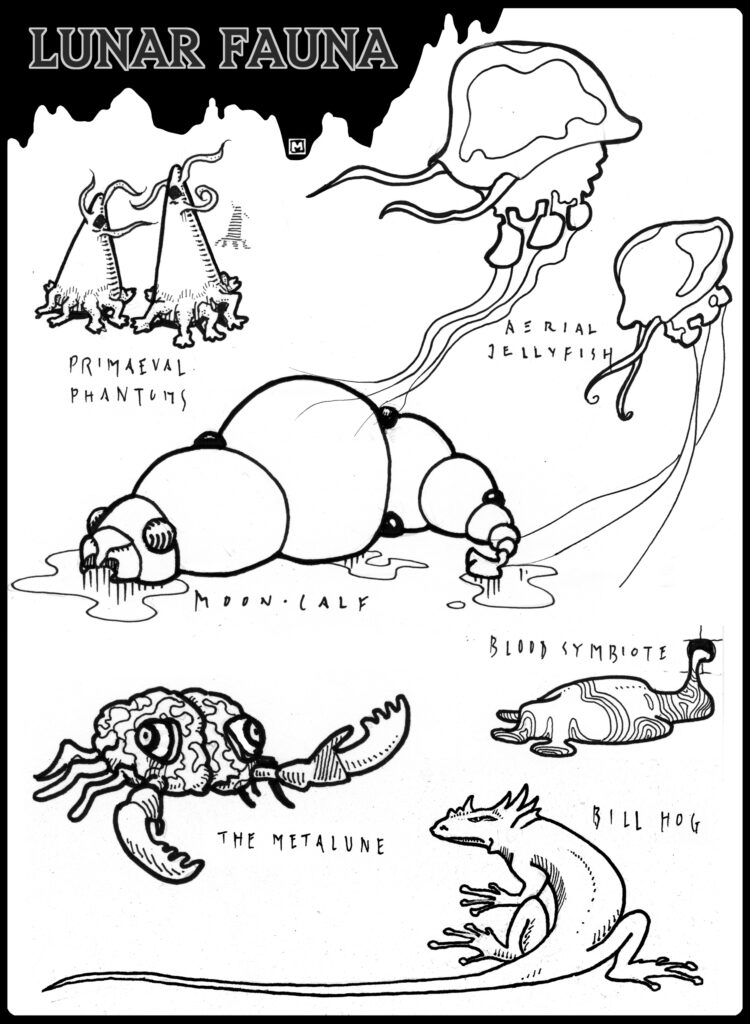
Animal life on the moon encompasses the same basic ecological niches that are found on Earth, and many other worlds – from micro-organisms and the maniform crawling things in the soil and the silt to herbivores, carnivores, and scavengers adapted to life in the ocean, sky, and among the different kinds of terrain on land. Many lunar animals belong to either a class with arthropod-like characteristics, a family that shares features with annelids as well as mollusks, or a category that shares traits with both reptiles and mammals.
Aerial jellyfish are shaped like globes or saucers. They are filled with gas bubbles that allow them to float through the air. They drag tentacles behind them, which they use to snare their prey.
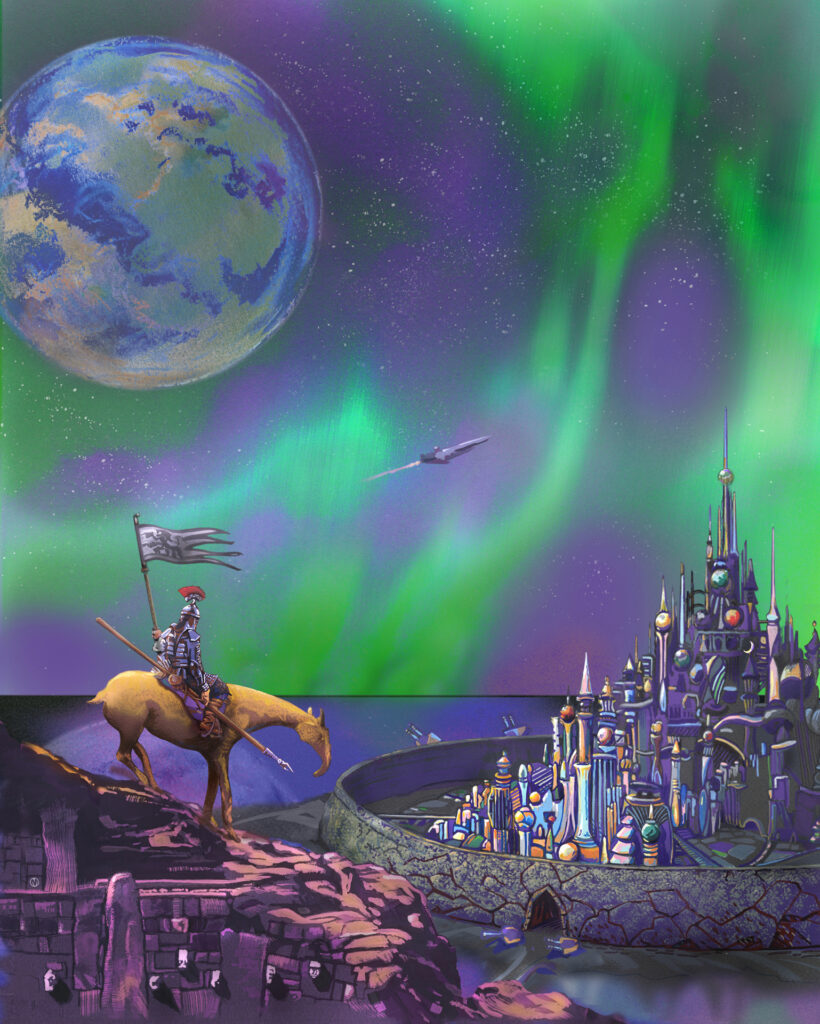
Gazelopes are slender four-legged herbivores with white, grey, or golden skins and a short proboscis. They are bred as both riding animals and for their meat. Wild gazelopes and those bred for war have long curved or spiral horns, while the other domesticated variants have none.
The vanak are the lesser cousins of the gazelopes, comparable in size to ordinary domesticated goats. These herbivores travel in herds of between a handful and a score. Vanaks are kept as livestock, and wild herds are hunted.
The vashoon are herbivores native to the Alabaster Meadows. They have short legs with sharp claws for digging and are covered in armor shells. Their narrow, wedge-shaped heads end in funnel-shaped snouts that are used to sniff out food. They are considered to be exceptionally filthy animals.
The aihor are twelve-legged serpent-like predators that can become up to 5’ long. They live in the Alabaster Meadows and eat small animals and aerial seed pods.
The Billhog is a lizard-like beast named after its sharp bill. In the Lunarian city-states, they are kept as domestic animals by the plebeians, who eat their eggs and meat. These usually docile animals can be goaded into a frenzy. Young animals can be trained to guard and fight. They can also be taught to perform tricks and parrot simple phrases.
Myrmonts are a kind of immense giant ants, comparable in size to a rhinoceros. They live among the mountains and are used as mounts and pack animals by the Lunarians.
Antorox are distant relatives of myrmonts, who rarely grow bigger than two feet in length. This predator hunts by hiding in the undergrowth to shoot itself as a projectile at passing prey, launched with the force of its strong hind legs. The javelin-shaped shell of the antorox is patterned and colored to blend in among leaves and fronds and is sometimes used for making jewelry or decorative clothing.
Sligs are six-legged vermin that come in packs (treat like Normal Rats). They are common pests in all lunarian cities. Unlike their terrestrial counterparts, sligs are eusocial and live in hives where a queen gives birth to sexless workers and warriors.
Ikosu, aquatic beings resembling a mix between fish and arthropods, inhabit the lunar seas, streams, and lakes. Their streamlined, elongated bodies feature a protective carapace, stalked antennae, mandibles, and compound eyes. The undersides exhibit six swimming legs, complemented by a horizontal tail fan for steering. These diverse species vary in size from one inch to an impressive 70 feet and play a significant role as a food source.
Many terrestrial birds, such as swans, swallows, nightingales, and woodcocks, migrate to the Moon for the winter. As the seasons pass on the Earth, the Moon is home to birds hailing from many different regions. The journey through the aethers of space takes between one and two weeks. How this habit once started is a mystery, but the bodies of migratory birds are sufficiently infused with aether to allow them to fly in the Moon’s thin atmosphere. Messages can be carried by the birds between the Earth and the Moon, in the manner of homing pigeons.